
If you’ve been to a dentist recently, you’ve probably had X-rays taken. Those quick, familiar images help us spot cavities between your teeth and check the health of your tooth roots. But not all dental images are the same.
At Congressional Dental Care in Rockville, we use two different types of imaging technology. Traditional digital X-rays are great for routine checkups. But for more complex cases, we turn to something far more powerful, CBCT scans. Let’s break down the difference, and why it matters for your care.
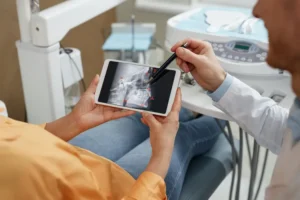
The Old Standard: Traditional Dental X-rays
Think of a traditional dental X-ray like a photograph of your teeth. It gives you a flat, two-dimensional image. You can see the general shape of your teeth and roots, and your dentist can spot cavities or basic bone loss. These X-rays are fast, affordable, and perfect for routine exams. We use them at most checkups to make sure nothing unexpected is happening below the gumline.
But traditional X-rays have a limitation: they compress a three-dimensional structure into a single flat image. That means important details can overlap or hide behind other structures. For example, a traditional X-ray might show that you’re missing some bone near a tooth. But it won’t tell your dentist exactly how wide, deep, or thick that bone loss is. And those measurements matter, especially if you’re considering a dental implant.
The Game Changer: CBCT Scans
CBCT stands for Cone Beam Computed Tomography. It sounds complicated, but all that means is it creates a complete 3D image of your teeth, jaws, nerves, and airways.
Imagine the difference between looking at a flat map of a city versus actually walking through the streets in 3D. That’s what CBCT technology does for dental treatment planning.
The scanner rotates gently around your head for about 20 to 40 seconds. It’s completely painless. And the level of detail is extraordinary.
Why 3D Imaging Leads to Better Care
Here’s where CBCT makes a real difference in your treatment:
- Precise Implant Placement: Placing a dental implant requires knowing exactly where your nerves and sinuses are. With a CBCT scan, Dr. Sarkarzadeh can plan the implant in 3D before ever touching your mouth. That means fewer surprises, less guesswork, and better results.
- Evaluating Jaw Anatomy: Not enough bone for an implant? A CBCT scan shows us the exact amount of bone you have, and exactly where. This allows Dr. Sina Farzin, our periodontist, to perform bone grafting with surgical precision.
- Diagnosing Complex Problems: Have a tooth that’s been hurting but X-rays look normal? A CBCT scan can reveal hidden damage, infected root canals, or abscesses that traditional images simply miss.
- Airway and TMJ Analysis: Because CBCT captures your entire jaw structure, it also helps us evaluate your airway for sleep apnea or examine your jaw joint for TMJ issues.
Safety and Comfort
Patients sometimes worry about radiation. Here’s the reassuring truth: a dental CBCT scan delivers radiation comparable to a few days of natural background radiation. For context, that’s far less than a medical CT scan of your head.
And unlike traditional X-rays that may require multiple images from different angles, a CBCT scan captures everything in one quick rotation. Less time in the chair. More information for your dentist.
The Congressional Dental Care Difference
Not every dental office in Rockville has a CBCT scanner. It’s an investment in technology that allows us to provide a higher standard of care. We use it because we believe you deserve accurate, safe, and excellent results.
Whether you’re considering dental implants, dealing with unexplained pain, or simply want the most thorough evaluation possible, CBCT imaging gives you and your dentist answers you can trust.
Have Questions?
Curious whether CBCT imaging might be right for your situation? We’re happy to explain. Call our Rockville office at (301) 276-4694 or request an appointment online.